
Mashatile: ‘No One Is Above the Law’ as He Owns the Record, Defends Loyalty and Charts Africa’s Path Forward

By Mpho Dube, Editor-in-Chief
The Azanian | Truth. Fearless. Unfiltered.
AZANIAFROCOMEDIA – The Catalyst of Impact
CAPE TOWN– It was a week that tested Deputy President Paul Mashatile on three fronts at once: accountability in Parliament, the rule of law in the presidency, and unity on the continent.
He didn’t dodge. He answered, owned his record, drew clear lines, and walked out with a message that cut through the noise: nobody is above the law, friendships don’t override rules, and Africa’s future depends on unity and delivery.
For a leader increasingly mentioned in conversations about who succeeds Cyril Ramaphosa after 2027, it was a week that looked less like damage control and more like a statement of intent.
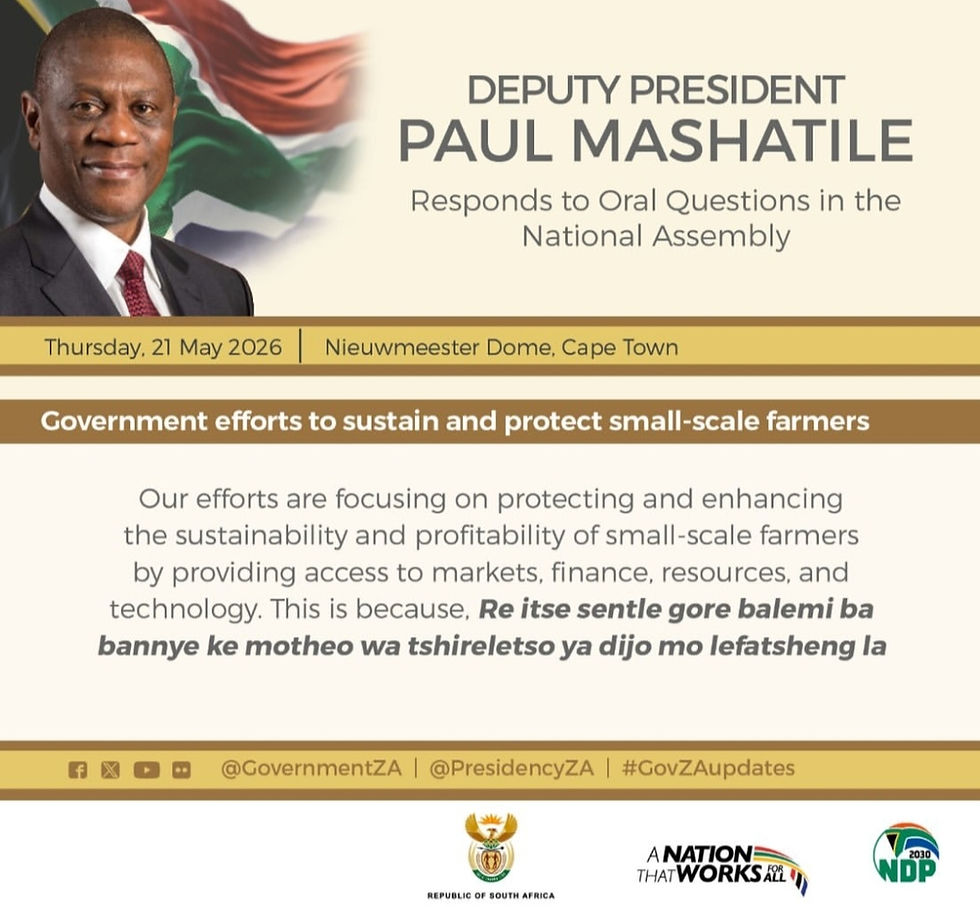
On Thursday, 21 May 2026, Mashatile stood in the National Assembly and took questions on issues that have dogged him for years. The diamond gift his wife received from businessman Louis Liebenberg came up again.
He didn’t deflect.
“The issue of the diamond was long dealt with by this House,” he said. “I accept, as you say, I’m wrong, and I will take responsibility and accountability, but so it must go for all of us.”
Parliament had already reprimanded him and imposed a R10,000 fine for failing to declare the gift. The matter had gone through the Ethics Committee. For Mashatile, that’s how the system is supposed to work.
“Where people have faulted, where mistakes have been made, then the rules must kick in,” he said.
He extended the same standard to the presidency. On the Phala Phala controversy, he defended President Ramaphosa’s decision to submit to Parliament’s process.
“Nobody is above the law. Not the president, not the deputy president, not ministers, not members of Parliament, all of us, abide by the law,” he told MPs.
“The president has committed to Parliament’s processes and will not avoid accountability.”
Mashatile also addressed his relationships with businesspeople now under public scrutiny. Some, he said, have been his friends for 20 to 30 years. Some were with him in jail during the Struggle. Today they run businesses. He runs government.
“They remain my friends, and they will remain my friends. I’m not going to walk away from them,” he said.
But he was clear that loyalty has boundaries.
“I will not do anything that is against the rules and interfere with procurement for the benefit of my friends; that I will not do.”
He challenged MPs to take any evidence of wrongdoing to the police, and pushed back on what he called a damaging assumption: that when black people become wealthy, it must be through irregular means.
“It’s even shameful if it’s said by a black man like yourself – I think we should respect the fact that black people are allowed to do business,” he told DA deputy chief whip Baxolile Nodada.
A day earlier, at the NEPAD @25 Business Breakfast in Century City, Mashatile turned to a different national flashpoint: the wave of anti-migrant protests and xenophobic violence sweeping several cities, including ongoing demonstrations in Durban.
He condemned them without qualification.
“While acknowledging concerns about illegal foreign nationals involved in crime, we strongly condemn the anti-migrant protest and xenophobic violence and urge law enforcement to address these issues through legal means, not mob violence,” he said.
He called the attacks “shameful” and said they “do not reflect the views of South Africans or government policy.”
His appeal was for calm, for respect for the constitutional order, and for closer cooperation between government, traditional leaders, civil society and migrant communities to tackle both crime and the rising tensions.
The NEPAD @25 platform gave Mashatile space to move from domestic accountability to continental vision. Speaking alongside former President Thabo Mbeki, he framed Africa’s next phase around three pillars: regional integration, economic collaboration and African ownership.
“Africa cannot afford fragmentation and isolation. Our strength lies in solidarity, in speaking with one voice and in pursuing shared objectives that transcend borders,” he said.
He laid out the scale of the challenge. Africa needs an estimated R3.16 trillion annually to close its infrastructure gap. Yet in 2023, the continent attracted only 2.3% of global renewable energy investment. More than half of Africa’s energy supply still relies on fossil fuels, leaving businesses exposed to volatile markets.
The solution, he argued, is moving “beyond commodity extraction toward value addition, industrial growth, and productive transformation” through the African Continental Free Trade Area.
“Now is the time to build on the native land. Not tomorrow. Not next year. But now!” he said.
With Ramaphosa set to step down after the 2027 general election, the race to succeed him is already being discussed in ANC circles. Some in the party and business community have floated billionaire and CAF President Patrice Motsepe as a preferred candidate. But Motsepe has publicly stated he is not contesting for the ANC presidency or the country’s top job.
Others have raised National Assembly Speaker Thoko Didiza as a potential first woman president, citing her long experience in government and her steady handling of Parliament.
Even with those names in the mix, Mashatile’s week positioned him as the most visible contender already operating at both domestic and continental level. He faced Parliament on the diamond gift and Phala Phala and didn’t hide. He defended loyalty without defending wrongdoing.
He condemned xenophobia when it was politically safer to stay quiet. And he used a continental platform to make the case for African self-determination and economic renewal.
It’s a combination of domestic accountability and continental statesmanship that few of his potential rivals can match.
“Nobody’s above the law,” he said. “Where we are wrong, we must accept and accept corrective measures, and we are doing so. That’s why these committees have been set up.”
In a political moment defined by suspicion and short tempers, that message stood out.
It didn’t sound like a campaign speech. It sounded like a leader governing in real time, and laying down a marker for what comes next.


Comments