
‘Polokwane Is Rising’: Residents Hail Mayor Mpe’s Turnaround as City Hits Metro Standards and Lifts ANC Hopes Ahead of November Polls

By Mpho Dube, Editor-in-Chief, The Azanian
13 May 2026, Polokwane
POLOKWANE – For years, residents here asked one question: when will the city work for us?
On 8 May, Executive Mayor Cllr Makoro John Mpe gave them an answer at Jack Botes Hall. And in the streets of Seshego, Mankweng and the CBD, the response is unanimous: finally, someone is delivering.
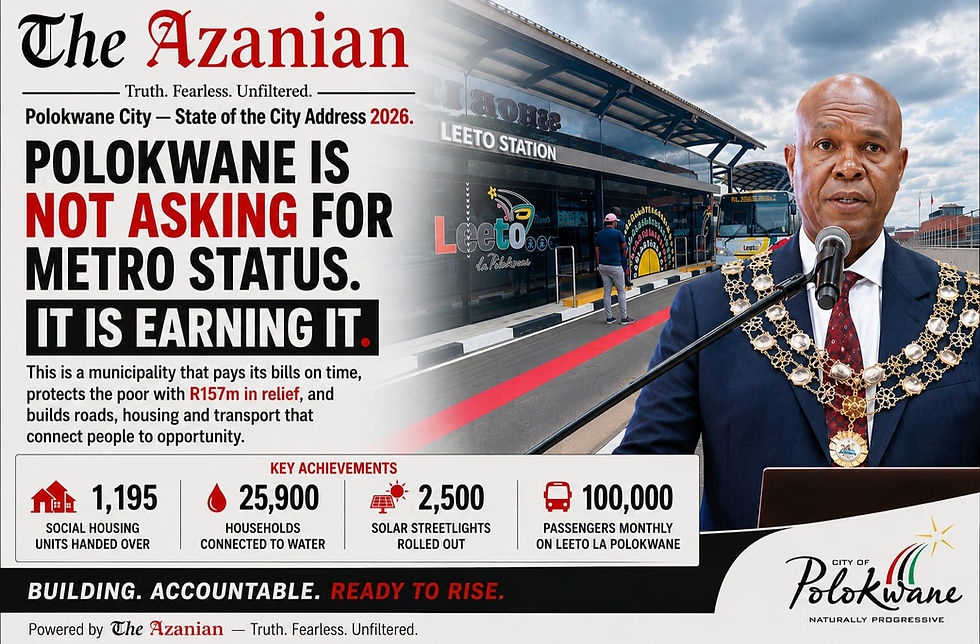
Polokwane’s 2026 State of the City Address didn’t read like a wish list. It read like a receipt. Four consecutive clean audits. Zero unspent conditional grants. 1,195 social housing units handed over. 25,900 households connected to water. 2,500 solar streetlights on the way. Leeto La Polokwane now moving 100,000 passengers a month.
“The new water treatment plant has made a huge difference in our lives. We no longer have to worry about clean water,” said Maria Phiri of Seshego, one of 25,900 households newly connected.
That’s the story residents are telling each other. Not promises. Pipes, lights, buses, houses.
Under Mpe’s leadership, Polokwane Municipality has moved from financial distress to financial soundness. The Auditor-General presented the city’s fourth consecutive unqualified audit opinion on 29 January 2026. Both the municipality and its housing entity, the Polokwane Housing Association, got clean audits.
“Excellence is becoming our tradition,” the city declared.
The numbers back it up. Unspent conditional grants dropped from R155.8 million to zero. For the first time in years, 100% of creditor invoices, including Eskom and Lepelle Northern Water, are paid within 30 days. Overtime costs fell from R113.6 million to R68.2 million.
And while fixing the books, the city protected the poor. R157 million is set aside to cushion indigent households against rising electricity and water tariffs.
A city building for the next level
Housing delivery has accelerated. Social housing stock now stands at 1,195 units. Annadale Extension 2 is complete with 290 families moved in. Another 404 units are under construction, with 150 more delivered in Extensions 126 and 127.
Water security has improved dramatically. The Seshego Water Treatment Plant now provides over 50% of Seshego’s water needs, adding 8-10 megalitres daily.
On safety and sustainability, 260 solar streetlights and 37 solar high mast lights went up this year. Another 2,500 solar streetlights and 40 high mass lights are planned for intersections and crime hotspots.
Catalytic projects like The Greenery, Green Arch Precinct, and the new Limpopo Central Academic Hospital are set to add thousands of jobs. Through EPWP alone, 22,640 work opportunities were created. Youth development is central: 117 graduates employed, 186 youth placed in municipal roles, 187 bursaries and 495 learnerships awarded.
Metro bound, and the ANC feels it. The turnaround hasn’t gone unnoticed at Luthuli House. In March, ANC Head of Presidency Sibongile Besani led a high-level delegation on oversight visits and called Polokwane Municipality “a paragon of service delivery” under Mayor Mpe’s leadership.
“Polokwane city has received four consecutive unqualified audit reports, and it’s clear that the people are being serviced,” Besani said.
That matters politically. Cllr Mpe, recently elected ANC Deputy Provincial Chair in Limpopo, is delivering where it counts – in the capital city. With local government elections due in November, Polokwane is shaping up as the ANC’s strongest card in the province.
If a municipality can move from financial distress to metro readiness in one term, it becomes more than administration. It becomes proof.
‘We are equal to the task’
Addressing residents, Mpe quoted Steve Biko: “It is better to die for an idea that will live than to live for an idea that will die.”
“We are equal to the task and we will not rest until every citizen has access to quality services,” he said.
Closing with Dickens, he added: “I see a beautiful city and a brilliant people rising from this abyss… It is a far, far better thing that I do, than I have ever done.”
“Long after speeches are forgotten, roads will remain tarred, water will flow, buses will move, and reforms will strengthen this municipality. That is legacy,” Mpe said.
For residents lining up for water that now runs, for youth in learnerships, for the 100,000 passengers on Leeto La Polokwane every month, the legacy is already visible.
Polokwane isn’t asking for metro status. It’s earning it. And in doing so, it’s giving the ANC something it hasn’t had in years in Limpopo: a story of delivery to take to the ballot box.



Comments